
MAKING A MASTERPIECE
‘Like a long dead ghost trying to make contact’: how Wilco made Yankee Hotel Foxtrot
Involving Cold War spy recordings, drug addiction and music industry landmarks, Wilco’s Yankee Hotel Foxtrot has been called a fable and a masterpiece. David Rea does a deep dive into the plots and subplots which created the band’s greatest album.
16 May 2026
THERE ARE MANY entry points into the labyrinthine story. Its uncanny connections to 911, or landmark Internet-first release; Reprise Records' then-president David Kahne listening to one of the most critically lauded albums of the 2000s and deciding Wilco should start again from scratch; Jay Bennett counting out the pills he'd had FedExed to the studio before the rest of the band arrived. Or perhaps it would be best to start further back: Jeff Tweedy perusing CDs in a record store and coming across one titled The Conet Project: Recordings of Shortwave Numbers Stations: encoded spy transmissions made over shortwave radio. 'The voices were so eerie,' Jeff Tweedy wrote, explaining the attraction, 'like a long dead ghost trying one more time to make contact.' On one section, against a storm of hiss, a woman's voice pronounced the same letters from the phonetic alphabet over and over: 'Yankee, hotel, foxtrot'. There was no response.
Most creative acts are never documented, but Wilco's era-defining, career high point, Yankee Hotel Foxtrot was, exhaustively so. It helped that the album had two captivating central plotlines: Jay Bennett being kicked out of the band during its making, and tragically dying of an overdose less than a decade later, and Reprise Records rejecting the finished record, only for it to be hailed as a masterpiece. The first had all the ingredients of a cautionary tale; the second became something of a fable for the record industry as it began the 21st century. Yankee Hotel Foxtrot's artistic achievement is matched by its cultural significance.
The Conet Project recordings made sense in the darkest corners of Jeff Tweedy's psyche. '...These solitudes exist so apart from each other in this sea of white noise and information,' he told Wilco biographer Greg Kot, 'and the beautiful thing is they keep transmitting to each other in the hope that somebody is going to find them.' The description seems to predict the America of today, a country atomised by the internet, but back then, for Jeff Tweedy, The Conet Project recordings described something more personal. 'The way people communicated or ultimately failed to communicate in The Conet Project,' he explained in his memoir, 'it's not all that different to me than my own efforts to communicate.' Those recordings, full of crackling static, might also have pointed Tweedy towards the album's experimental noise and abrasive soundscapes. They certainly conveyed the sometimes tense atmosphere in the studio while the band made the album, and the escalating struggle of Jeff Tweedy and Jay Bennett to hear one another.
Before they were even worked on in the studio, the songs were already remarkable. With polished vocal melodies, killer hooks and captivating lyrics, they had the sinew to withstand the band's mercilessly adventurous deconstructions. We can hear a stripped-down version of 'I Am Trying to Break Your Heart' at the start of Sam Jones' making-of documentary, I Am Trying to Break Your Heart: A Film About Wilco, as Jeff Tweedy drives through Chicago, all bleary-eyed, with five o'clock shadow, oblique sunlight coming through the car window. It is a sweetly dark acoustic indie track with kooky, surreal lyrics. Another song 'Poor Places' is heard in pared-back form a few minutes later in the film. We watch the band sitting in a circle, acoustic instruments in hand, trying to figure the song's direction out. Former Reprise executive Gary Briggs: 'I've heard song demos of Jeff's and said, "God, that is built for radio, Jeff!"'. These two early 'demos' are cases in point. In the hands of the Wilco who made the power pop-adjacent Being There, they might well have become radio-friendly hits.
The band had been in transition from punk-adjacent alt-country rockers to studio nerd wizards for some time. Jay Bennett, a multi-instrumentalist and accomplished engineer, joined the band in time for Being There. Glenn Kotche, a drummer and percussionist with an eye for detail, who had been briefly tutored by The Velvet Underground's Maureen Tucker, replaced ex-Uncle Tupelo drummer Ken Coomer. By the time the band came to record Yankee Hotel Foxtrot, Wilco had also transplanted operations to their own creative work-cum-living space, a 4,000-square-metre loft on the Northwest Side of Chicago. Designed for optimum creative flow, it was kitted out with multiple mixing desks and shower and came with a small team of engineers.
In addition to inspiring the album's title, central theme and particular sound textures, the voices on The Conet Project recordings were not so different from the band's blind creative search in making the album. 'Uh, okay?' Jeff Tweedy says in Sam Jones's documentary after a particularly garage-rock take of 'Kamera'. His uncertain intonation typified the sense of a band journeying through the unknown, guided only by instinct. How exactly would they know when they'd found the right drum sound, guitar tone or studio trick? How exactly did they know to run Stravinsky back through a synthesizer, as they did for a section on 'Heavy Metal Drummer'?
Did you know?
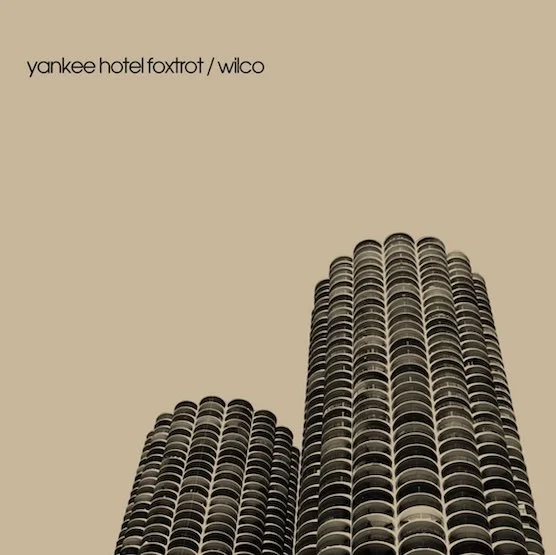
The photograph on the cover of Yankee Hotel Foxtrot was taken by Sam Jones, who directed the documentary I Am Trying to Break Your Heart: A Film About Wilco.
Following the use of the sample from the Conet Project (a voice repeating: ‘yankee, hotel, foxtrot’) on the song ‘Poor Places’, Irdial-Discs successfully sued the band for copyright infringement.
According to Greg Kot’s Wilco: Learning How to Die, YHT is Wilco’s most commercially successful album. It sold in excess of 55,000 copies during its first week and landed in the Billboard pop-album chart at number 13. Since then it has sold more than 400,000 copies.
In our current age of carefully edited music documentaries, in which every moment of vulnerability feels carefully calculated, I Am Trying to Break Your Heart: A Film About Wilco feels genuine and edgy. It is a fascinating warts-and-all document, but it also appears to have warped the process it observed. Jeff Tweedy never got used to having the cameras around. 'Maybe the camera is like a fly on the wall but it's a type of fly that you always know is there and you can't stop thinking about it,' he later reflected. (Do the lyrics to 'Kamera' capture Tweedy's paranoia: 'I need a camera to my eye / To my eye reminding / Which lies have I been hiding'?) Tweedy also wondered if the cameras impacted Jay Bennett's behaviour: '(He) liked to see himself as a bit of a mad scientist in the studio... the cameras seemed to be pushing him toward that idea of himself to the exclusion of all other aspects of his personality.' Bennett created an uncomfortable atmosphere in the studio, Tweedy later wrote, talking about bandmates behind their backs. When he and Tweedy were alone, he even suggested they complete the album without the rest of the band.
It eventually became clear the songs had partly vanished in the experimentation. The man to pull them back from the brink, Jim O'Rourke, would ironically later co-produce Wilco's most experimental album, A Ghost is Born. Jeff Tweedy gave him 'I Am Trying to Break Your Heart'. Three days later, O'Rourke returned the song transformed. As Jay Bennett described it, 'It was a freaky, fucked-up song, and he made sense out of it.'
What followed was a well-documented comedy of errors and misjudgments. Then-President of Reprise David Kahne and A&R Mio Vukovic listened to the finished album, decided it had no hits and gave the band an ultimatum: start again or be dropped. One wonders how closely they really listened to the record, and how much they were influenced by the opener 'I Am Trying to Break Your Heart'. Despite Jim O'Rourke's concise new mix, that track probably remained the album's most experimental.
Negotiating Wilco's exit, Reprise ended up giving the band the master tapes for free. Nonesuch Records, a subsidiary of the same AOL Time Warner conglomerate as Reprise, signed Wilco, meaning the parent company paid for the same album twice. Foreshadowing the music industry to come, Wilco streamed the whole thing online ahead of its physical release. Finally landing on record store shelves, somehow miraculously coherent and complete given its tangled production subplots, the album was critically acclaimed. Uncut said it was the Americana equivalent of Radiohead's Kid A, and Pitchfork called it a 'masterpiece' giving it a perfect 10.
It is too easy to see Yankee Hotel Foxtrot as a victory of art over commerce. Given the album was unlikely to return much profit, there appeared little choice for Wilco but to leave Reprise with the masters in hand: 'It was a choice of making a record we didn't like and not making any money,' Tweedy wrote later, 'or making a record that we loved and not making any money'. Neither was the decision to stream it for free online a righteous prioritisation of fans before profit. Risky it might have been, but there was business savvy at play too. At the time, the band had a substantial fanbase and were darlings of the music press. Streaming Yankee Hotel Foxtrot fed both, driving sales of tour tickets, creating a buzzworthy story and giving the album considerable underground lustre. If the band had wanted to light an attention-grabbing touchpaper ahead of the physical release, they couldn't have done a better job.
There is an alternative history to the album. Had Reprise Records loved the record, then it would have been put out on its original release date: 11th of September 2001, available in record stores at almost exactly the same time American Airlines Flight 11 hit the World Trade Centre's North Tower. The fact the album had duplicated towers on the cover (Chicago's so-called Corn Cob Towers), contained the lyrics 'tall buildings shake' and a song called 'Ashes of American Flags' would have lent the album a creepily prophetic quality. Jeff Tweedy has said the original 911 release date would have probably resulted in the album being pulled from shelves.
Randomness also plays a role in Jay Bennett's story. What he and Jeff Tweedy found together was that rarest of things: friction that created the brightest of sparks. It produced Wilco's most enduring music. After he left the band, Sam Jones's documentary features a brief scene of Bennett playing in a small club. ‘When you're Jay Bennett or whomever and you leave a band, you have to start over,' Tony Margherita commented at the time, 'you're going back to playing for 35 people, 100 people.' Eight years after he had departed, after several solo albums that failed to break through, Jay died of an overdose. 'It was hard to be surprised, but that didn't make it any less heartbreaking,' Tweedy said, adding: 'I wouldn't have been surprised to see him onstage with Jackson Browne or Elton John or even Paul McCartney. He would have made almost any band better if he'd been able to get help'.
Jay Bennett certainly made Wilco better. Yankee Hotel Foxtrot is a lasting testament to his talent, and his friendship with Jeff Tweedy, documenting its disintegration in the fizzing static of creative friction.
© 2026 State of Sound. All Rights Reserved.
David Rea
David Rea is a journalist who writes about the intersection of music, culture and history. He is the founder and editor-in-chief of State of Sound. His fiction has recently been featured in Oyster River Pages and Catamaran Literary Reader, and long-listed for the Commonwealth Short Story Prize. He is currently writing a history of British popular music and a historical novel set in the USSR and Hollywood during the interwar period. He lives just outside London with his wife and two sons.
Photo: Arthur McLachlan Rea

RELATED

RELATED
HOW THEY WROTE THE SONG
by David Rea
31 January 2026