FEATURE
John and Yoko’s bed-in: The forgotten song they recorded after the cameras left
The countercultural media circus, which produced the single ‘Give Peace a Chance’, was recorded for posterity by countless cameras. But after they had left, John and Yoko made another recording. Read the story behind the song everybody missed.
By David Rea
Photo: Pictorial Press Ltd / Alamy Stock Photo
11 April 2026
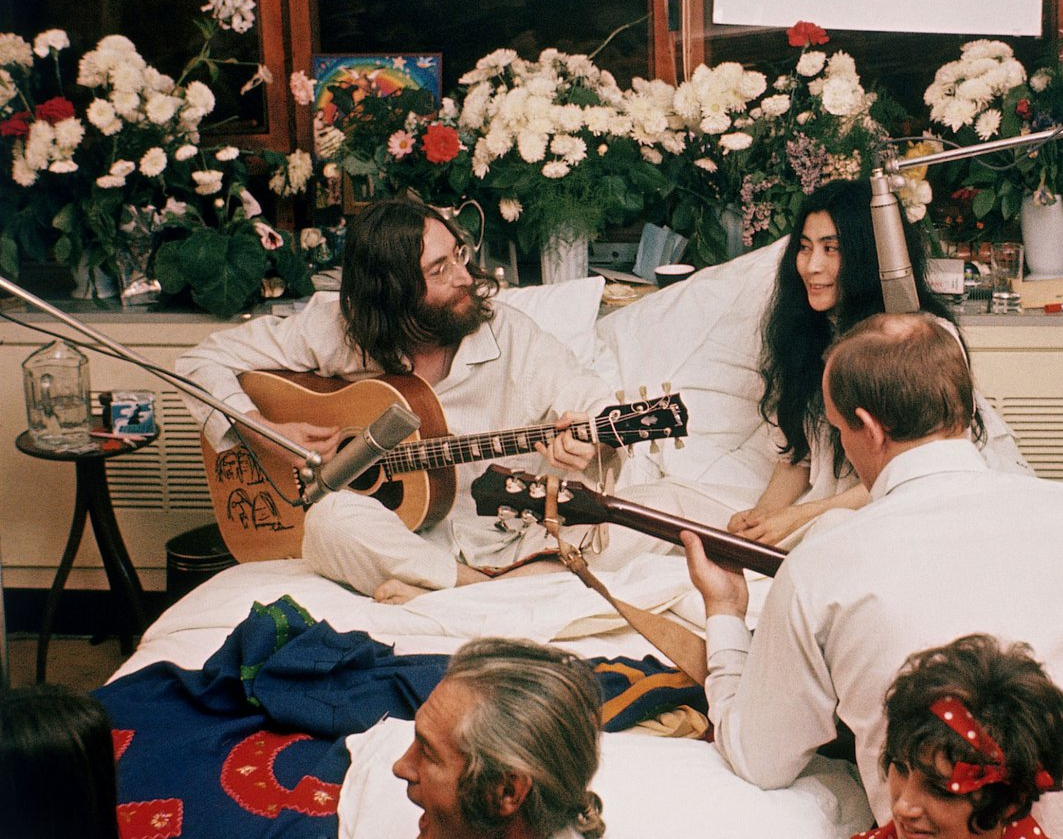
CAMERAS CLICKED. Microphone wires were unwound. You could feel the charged atmosphere everywhere you looked. Journalists in shirts and ties couldn’t keep the smiles from their faces; others looked bashful. They all knew the five-minute recording they were about to make would become history. Sitting at the centre of it all was one of the most famous people on the planet, John Lennon, giving off the sort of supercharged charisma that made people blush or look away. With his long hair, beard, wire-rimmed spectacles and white clothing he looked like a cross between Gandhi and Jesus. Sitting cross-legged on the bed beside him, Yoko Ono looked so tiny she almost seemed to vanish. The tape began to turn, producer André Perry put on his headphones and John Lennon counted in: ‘one, two, one, two, three four…’
After the applause and cries of ‘Hare Krishna’ had faded, the cameras been put away and the crowd filed out, there was, at last, quiet in hotel room 1742. All that remained were the bouquets of flowers, the home-made signs declaring ‘hair peace’ and ‘bed peace’ – Yoko Ono, John Lennon and André Perry. Now that Lennon's first solo single ‘Give Peace A Chance' was in the can, it was time to record the B-side, Yoko’s first single released with John, ‘Remember Love’. It was the A-side’s opposite, a private meditation on love after the very public chant for peace.
As Perry told the Times Herald-Record, the small hotel room was an acoustic nightmare with its low ceilings, and Perry only had a cumbersome RCA Victor 4-track to work with, rented for the occasion. As John and Yoko lounged about on the floor, Perry positioned himself directly in front of them five feet away. After his messianic vocal on ‘Give Peace A Chance', Lennon turned down his high-voltage charisma, disappearing behind an acoustic guitar.
“Perhaps it is the paired-back production or the special atmosphere in the room, but Yoko's fragile voice almost gains the status of texture, the way whispers do in the dark.”
Artists live with an irreducible tension, compelled to excavate their interior lives to create, then search for validation in the public glare of flashbulbs. John Lennon and Yoko Ono appeared at ease with the contradiction, documenting so much of their private lives on film; in the case of the Amsterdam ‘Bed-In for Peace’, they turned their honeymoon into a media circus.
On the recording of ‘Remember Love’, their private/public space reached an extraordinary hold-your-breath tension. The song is like a confidential communication from Yoko to John just after waking, picked up by recording equipment accidentally left on nearby. The sense this is not for public consumption is compounded by Lennon's guitar being slightly out of tune and Yoko not always quite coming in on time. We feel we are trespassing, that if we make a sudden movement we might startle them.
Perhaps it is the paired-back production or the special atmosphere in the room, but Yoko's fragile voice almost gains the status of texture, the way whispers do in the dark. Her voice is so quiet we can hear the movements of her lips and mouth. The faint click of her tongue, her swallowing before beginning a verse.
Perry later told Sandy Tomcho: ‘they were beautifully in love and he was very, very sweet and they used to go in the bed and tickle and laugh and so on.’ Eventually they got the take they were looking for.
The song and its recording may well have influenced some of John Lennon's post-Beatles compositions. We find a similar acoustic guitar-backed production on ‘Working Class Hero’, and melodically, the simple nursery rhyme feel of ‘Remember Love’ comes through on ‘My Mummy’s Dead’. More obviously, the song’s idealised aphorisms find a clear echo on ‘Oh My Love’ (which Lennon and Ono co-wrote and which turned up on the album Imagine) and ‘Love’, which appears on John Lennon/Plastic Ono Band. Some of this can be attributed to the influence of primal scream therapy, of course, and Lennon's root-and-branch identity reconstruction after the Beatles, but we can also hear the influence of a small hotel room in Montréal, with ceilings too low for high-quality recording, and Yoko Ono singing just above a whisper, with the vulnerability of child.
© 2026 State of Sound. All Rights Reserved.
David Rea
David Rea is a journalist who writes about the intersection of music, culture and history. He is the founder and editor-in-chief of State of Sound. His fiction has recently been featured in Oyster River Pages and Catamaran Literary Reader, and long-listed for the Commonwealth Short Story Prize. He is currently writing a history of British popular music and a historical novel set in the USSR and Hollywood during the interwar period. He lives just outside London with his wife and two sons.
Photo: Arthur McLachlan Rea