THE ‘ONE TO WATCH’ INTERVIEW
Annick Odom: ‘My dad used to sing to me and my sister at bedtime. He was one of my first influences’
Belgian-American composer and multi-instrumentalist, Annick Odom on reimagining her Appalachian heritage and the five-year journey of making her album Linen of Words
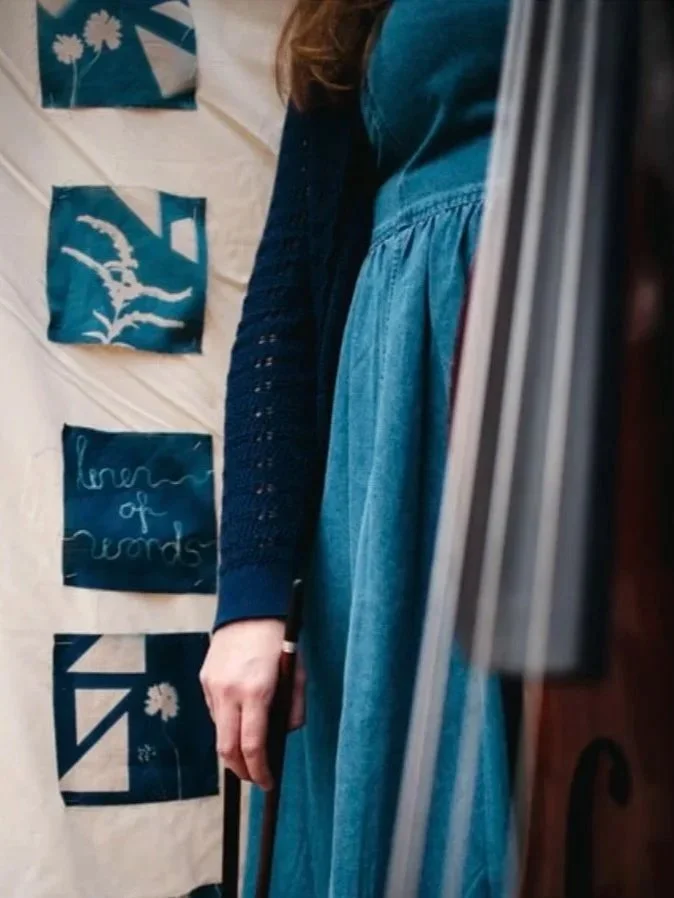
Photo courtesy of Lauren Bowlin Photography
1 May 2026
State of Sound: What is your earliest memory of hearing music?
Annick Odom: I'm not sure if it's my very earliest memory, but my dad used to sing to me and my sister at bedtime, songs like 'Swing Low, Sweet Chariot', 'Pocket Full of Stardust' and 'Summertime'. I think hearing my dad sing, and the way he would tell stories along with them, about his old cat Boris or his old dog Buddy, made music feel very personal to me from a young age. When I did get interested in field recordings, I think it reminded me of those moments and I was drawn to that kind of intimacy of hearing someone sing unaccompanied in their own home.
Was there a music fan in your early life who you looked up to and influenced your music taste?
Definitely! My dad was one of my first influences. He loves older black-and-white films, and I remember him talking about musicians like Benny Goodman and Artie Shaw, and telling me that he used to play clarinet himself. That's actually why I picked up the instrument.
My relationship to music started partly through his listening habits and his curiosity. Through the years, the clarinet has stayed with me and even found its way back into my work now, including on my new album. He also is the person who gave me many of my first albums, which often featured instruments I played (clarinet and bass in particular). I remember my dad giving me two CDs the week I decided to play bass: one by Edgar Meyer (The Goat Rodeo Sessions) and one by Esperanza Spalding (Chamber Music Society). Those were really formative. They showed me early on that the bass could be both the rhythmic foundation of a song and play expressively, and that singing and playing could exist together in a really fluid way.
Is there a song/album/record which changed everything for you?
There isn't just one... it's more like a series of shifts over time. Those early bass records were important, but later on I was really struck by the work of Anna & Elizabeth, especially how they combine traditional material with visual storytelling called 'crankies'.
And artists like Cécile McLorin Salvant have made me think a lot about transitions, how you move between pieces, between moods, between genres, and how that can be part of the storytelling itself.
What is the record you have probably listened to the most in your life?
It's so hard for me to say, but it's probably one of the field recordings I've gotten from the archives in West Virginia. I've listened a lot to non-commercial home recordings of the late West Virginia ballad singer and storyteller Phyllis Marks: very direct, unaccompanied recordings. Many of those songs and stories, which I first heard her sing sitting knee-to-knee in her living room, have made their way onto Linen of Words in some form. Those kinds of recordings don't really wear out for me. Each time I hear something slightly different in the phrasing or the pacing, and I listen a lot because I'm trying to keep the way the person I learned from sang in my mind.
“A lot of my songs start from curiosity. There's usually something I want to understand better, a story, a fragment of text, or even just a feeling that doesn't quite resolve.”
What is the greatest gig you've ever seen?
When I first started playing bass, I went to the International Society of Bassists convention and saw Ron Carter play jazz bass. He was with other musicians, but all I noticed was him. It was the first time I really remember seeing someone play the instrument live at that level. He was incredibly generous as a performer, very present, very human, and also just unbelievably good. That combination left a big impression on me. I also remember it because before the gig I had been sitting with him at a lunch table in the cafeteria, and he'd been so nice! I hadn't known who he was at all, and that always really stuck with me; that he was so friendly and humble, even when he was basically the closer at this conference and a world-renowned bassist.
Could you say something about your creative process? How does a song tend to come together for you?
A lot of my songs start from curiosity. There's usually something I want to understand better, a story, a fragment of text, or even just a feeling that doesn't quite resolve.
Sometimes it's also about contrast, like a melody that feels bright or playful paired with a darker subject, or the other way around. I'm interested in how those layers can coexist or be put side by side.
From there, I tend to build outward: adding instruments or textures that either support or gently complicate the sentiment, rather than just reinforcing it.
A lot of the songs and the arrangements on my album came from improvising alone or with groups, even the traditional songs I messed around with a lot in this way. I love weird sounds and textures, and I love moving away from rhythm into free moments as well. I think there's a lot of that in my music in general.
“The album became a kind of meeting place between traditions, between people, between ways of listening.”
Your new album Linen of Words was released on April 14, bringing together your own compositions and reimagined folk ballads. It was made in collaboration with over 20 musicians spanning folk, jazz, classical, and experimental traditions. How do you feel now that the album is out in the world and could you tell us something about how the album came together?
I'm really excited that it's out, and also a little disoriented, in a good way. It took about five years from the earliest ideas to the final release, so it lived as a process for a long time.
Some songs started with archival material (letters, ballads, fragments) and others from my own writing. I worked with musicians across folk, jazz, classical, and experimental backgrounds, and each collaboration shaped the music differently.
The album became a kind of meeting place between traditions, between people, between ways of listening. I really wanted to show the world the many wild ideas I had, and most of them involved mixing different styles and traditions, so getting to work with such a large palette of personalities and sounds was a great joy. I also really love storytelling and old folk songs, so I wanted to give them a new life and to invite some of my favourite musicians who are not from those traditions to be playful with that material as well.
You have been involved in a number of projects in recent years, including Wake Robin, a folk group drawing from old-time traditions, the folk revival, early bluegrass, and their own original songwriting, and Sweet Joe Pye who perform ballads and fiddle tunes hailing from the Appalachian mountains as well as original compositions. From the outside it feels like you are driven by a pure love of traditional music and collaboration. Is that the case? Do you have any desire to reach a larger audience?
I do really love traditional songs, and I love working with other musicians; that's definitely at the centre of what I do. I think I become a better musician when I get to work with other great musicians, and I love seeing what others bring to my ideas and how they change and are strengthened through collaboration.
Of course, like most musicians, I'd love for my work to reach more people. But what matters most to me is making something that feels genuinely engaging and alive, something I'm curious about and invested in. If that connects widely, that's wonderful. But the starting point is always the work itself.
A feature of the music you make is close harmonies. Can you tell us something about what draws you to close harmonies?
I just love singing with people, in particular the folks on my album! Close harmony has this feeling of both blending and tension, you can hear the individual voices, but also something that happens between them. It's really addictive.
A lot of the early country and bluegrass music I love has that quality, and I've been lucky to work with incredible singers like Tessa Patterson and Hannah Standiford. There's something very immediate and physical about that kind of sound. I'd happily sing with others all day.
You have talked elsewhere about learning American ballads from elders in the Appalachian region. What is your connection with Appalachian culture and music? How much does celebrating/conserving/preserving Appalachian culture play into your motivation?
I'm from Morgantown, West Virginia, so that connection is both personal and cultural. Growing up, I often felt like the message was that you needed to leave to be successful, that what was local wasn't enough.
Part of what motivates me now is pushing back against that idea a bit, to say that there is a lot of richness here, and that it's worth paying attention to.
At the same time, as someone who is half-Belgian, I'm also really interested in the movement of people and stories, the way traditions are shaped by migration and exchange. So for me it's not just about preserving something unchanged, but about engaging with it, questioning it, and reimagining it in a way that still respects where it comes from.
So what's next for you? What are you recording and performing plans?
I'm interested in moving toward something a bit more stripped down next, closer to what I sound like as a solo performer. Linen of Words was a chance to explore a really expansive, collaborative sound world, which I loved.
Now I'm curious about what happens with just voice, bass and clarinet, how much space I can create with fewer elements.
I also have a number of performances coming up around Pittsburgh and Morgantown with Wake Robin, and I'm planning to develop more solo shows over the next year alongside some new recording ideas.
© 2026 State of Sound. All Rights Reserved
RELATED
THE ‘ONE TO WATCH’ INTERVIEW
Questions by David Rea
11 October 2025
THE ‘ONE TO WATCH’ INTERVIEW
Questions by David Rea
25 October 2025

THE ‘ONE TO WATCH’ INTERVIEW
Questions by David Rea
6 September 2024